Customers should look to have 10’ of space to accommodate scorer’s tables and should design their visitor side bleachers to make room for scorer’s tables. This may include shortening rows of bleachers to make room for team seating and scorer’s tables.
When interacting with large-scale gymnasium projects, a question that emerges for customers is fitting a scorer’s table into the design of a gymnasium. Below are some key considerations for architects to weigh when faced with these design questions:
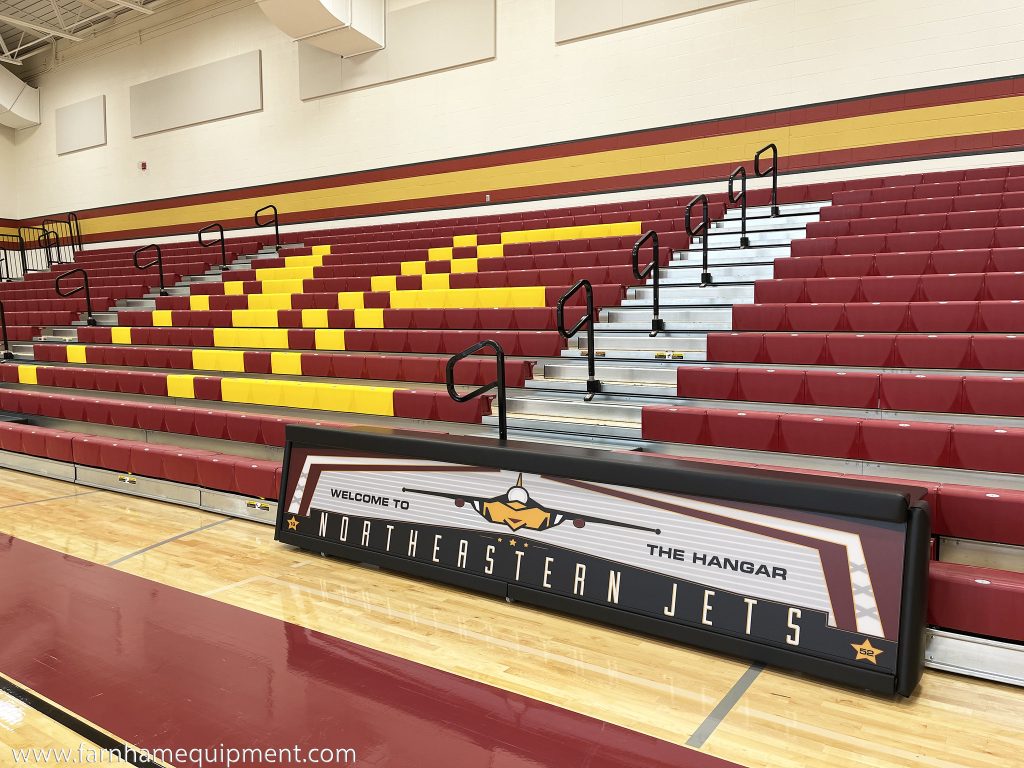
- Make designs for scorer’s tables to be on the visitors’ side. In decades of experience, Farnham Equipment Company (FEC) has seen that 99% of the projects involving scorer’s tables go on the visiting area.
- Consider lowering your row count on the visitor side bleachers. For instance, if the visitors’ row is set to have 14 rows of seating, but the customer wants to accommodate a scorer’s table, making the change to 12 rows will allow for adequate space from the first row to the court line.
- In several instances, there is both team seating and a scorer’s table that takes up space. Without adequate space between the court line and the first row of bleachers, customers will find their walkway stymied. FEC’s suggestion is to have at least 10 feet of space between the first row of seating and the court line to have adequate walk space for patrons.
Working off of these principles will give architects a better design that allows for team seating, scorer’s table, and adequate bleacher seating all in one.